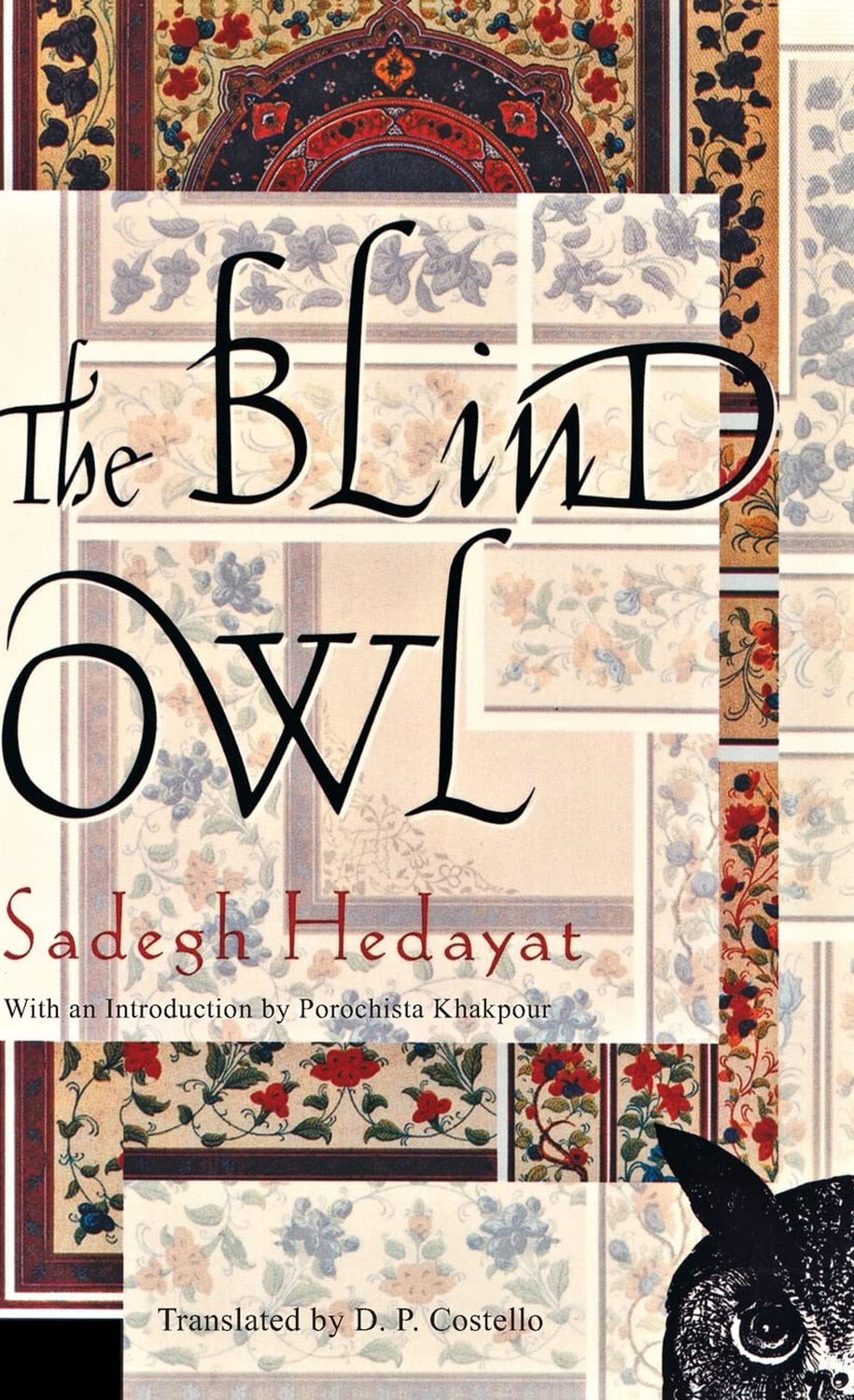
The Blind Owl by Sadegh Hedayat

About the Book

"The Blind Owl" (Būf-e Kūr), which is regarded as the most important work in Persian literature and has been translated into various languages around the world, is a novel by Sadegh Hedayat that places him among the prominent writers of the world. Some scholars suggest that the title "Blind Owl" is inspired by a novel by the Belgian author Franz Hellens and refers to sexual instinct.

The book is rich in multiple symbols, and many literary critics are still exploring their meanings. The main story of Hedayat's acclaimed novel revolves around the life of a young man who is isolated and spends his life in solitude. As he is one of the intellectuals of his time, he attempts to gain a better understanding of himself away from society.

Consequently, he faces challenges, including psychological crises, which compel him to resort to drug use and experience hallucinations. For this reason, what is narrated through his voice is sometimes unreliable, leading the reader to encounter difficulties in discerning the true essence of the story. The author skillfully depicts the madness of the narrator, which in a way reflects Sadegh Hedayat's perspective on the conditions of modern humanity. Ultimately, a reader who chooses "Blind Owl" for their reading will find it hard to erase from their memory what they have read for a long time, as it leaves behind an atmosphere filled with ambiguity and complexity.

About the Author

Sadegh Hedayat, born on February 17, 1903, was one of the greatest intellectuals, translators, and writers in Iran. He completed his university studies at the Faculty of Fine Arts at Tehran University and during his stay in Europe, after becoming acquainted with world literature, he developed an interest in the works of Edgar Allan Poe, Chekhov, Dostoevsky, Kafka, and Maupassant.

In 1928, Hedayat attempted his first unsuccessful suicide. He worked for a time at the National Bank and later joined the Department of Music, eventually becoming the editor of a music magazine. Hedayat ultimately surrendered to death on April 8, 1951; some attribute this to gas poisoning while others consider it a suicide. His most notable works include "The Stray Dog," "Dash Akol," "Haji Agha," and "Three Drops of Blood."

Who should read this book?

It is recommended for those interested in surreal literature in Persian to read "Blind Owl" at their earliest convenience and with proper focus.


Book Quotes

In life, there are wounds that gnaw at the soul like a worm, slowly consuming and grinding it down in isolation. These pains cannot be expressed to anyone, as people generally tend to regard these incredible pains as rare and strange occurrences. If someone dares to say or write about them, people, according to their prevailing beliefs and opinions, try to interpret it with a skeptical and mocking smile. Because humanity has yet to find a remedy for such pain, and the only cure is forgetfulness through wine and artificial sleep induced by opiates and narcotics. But alas, the effect of such remedies is temporary, and instead of alleviating the pain, they eventually intensify it.
Will anyone ever uncover the secrets of these supernatural events, this reflection of the soul's shadow that manifests in a state of stupor and limbo between sleep and wakefulness? I will only describe one of these occurrences that happened to me, an event that shook me so profoundly that I will never forget it, and its mark will poison my life from the day I was born until eternity, as far as it lies beyond human understanding. I wrote "poisoned," but I meant to say.
I felt how weak and childish religion, faith, and belief are in the face of death; they seemed almost like a pastime for healthy and happy individuals. In the face of the terrifying truth of death and the heart-wrenching states I was experiencing, what I had been taught about punishment and reward for the soul and the Day of Resurrection had become a tasteless deception, and the prayers I had been taught had no effect against the fear of death.
A few days ago, someone brought me a prayer book that had a layer of dust an inch thick on it. Not only did the prayer book not serve me, but no book or writing or thoughts from the lowly mattered to me. What need did I have for their lies and nonsense? Wasn't I the result of a lineage of past generations, with their inherited experiences still within me? Wasn't the past contained within me? Yet, neither the mosque nor the call to prayer nor ablution nor bowing down in front of an omnipotent being ever had any effect on me...

Download book

Buy on Amazon
  • Publisher ‏ : ‎ Grove Press
  • Publication date ‏ : ‎ October 12, 2010
  • Edition ‏ : ‎ 60309th
  • Language ‏ : ‎ English
  • Print length ‏ : ‎ 160 pages
  • ISBN-10 ‏ : ‎ 0802144284
  • ISBN-13 ‏ : ‎ 978-0802144287
  • Item Weight ‏ : ‎ 5.6 ounces
  • Dimensions ‏ : ‎ 5.5 x 0.5 x 8.25 inches
  • Best Sellers Rank: #227,951 in Books

Related Books

wave
Toxic People by Lillian Glass
How to Help Your Husband Get Ahead by Dorothy Reeder Carnegie
Crime and Punishment by Fyodor Dostoyevsky
Man's Search for Meaning by Viktor E. Frankl
Crenshaw by Katherine Applegate
The Chakra Handbook by Shalila Sharamon
After You by Jojo Moyes
The Odyssey by Homer
War and Peace by Leo Tolstoy
The Compound Effect by Darren Hardy
Add Review
wave
reload, if the code cannot be seen
Looking for...?